What Eleuthera's Communities Said About Their Future
In February and March 2026, the Organization for Responsible Governance conducted an independent community survey and three structured focus groups across central and south Eleuthera. The following is a summary of their findings. Additionally, On August 13, the community confirmed in person what the research found: when the developer asked a full Workers House for a show of hands in support of his Crown land partnership, one hand went up.
An Independent Baseline of Community Perspectives
The Organization for Responsible Governance (ORG), a nonpartisan Bahamian nonprofit, conducted this research as part of a broader commitment to strengthening participatory governance in The Bahamas. The survey was carried out using a walkabout methodology — direct, in-person engagement across settlements from Hatchet Bay to Tarpum Bay — designed to reach residents across income levels, occupations, and age groups.
The research was conducted in the context of the proposed Jacobs Resort Development, a large-scale project in the Governor's Harbour area that has been described as including resort, marina, casino, golf course, and vacation residence components across an ocean-to-ocean footprint. The survey gathered both quantitative responses and open-ended qualitative input, complemented by three structured focus groups held across central and south Eleuthera.
Environmental Health Is Central to Life on Eleuthera
The survey found near-unanimous recognition that Eleuthera's natural environment is inseparable from the island's economy and way of life. Residents' relationship to the land and sea is not abstract — it is the foundation of livelihoods, culture, and daily life across every settlement surveyed.
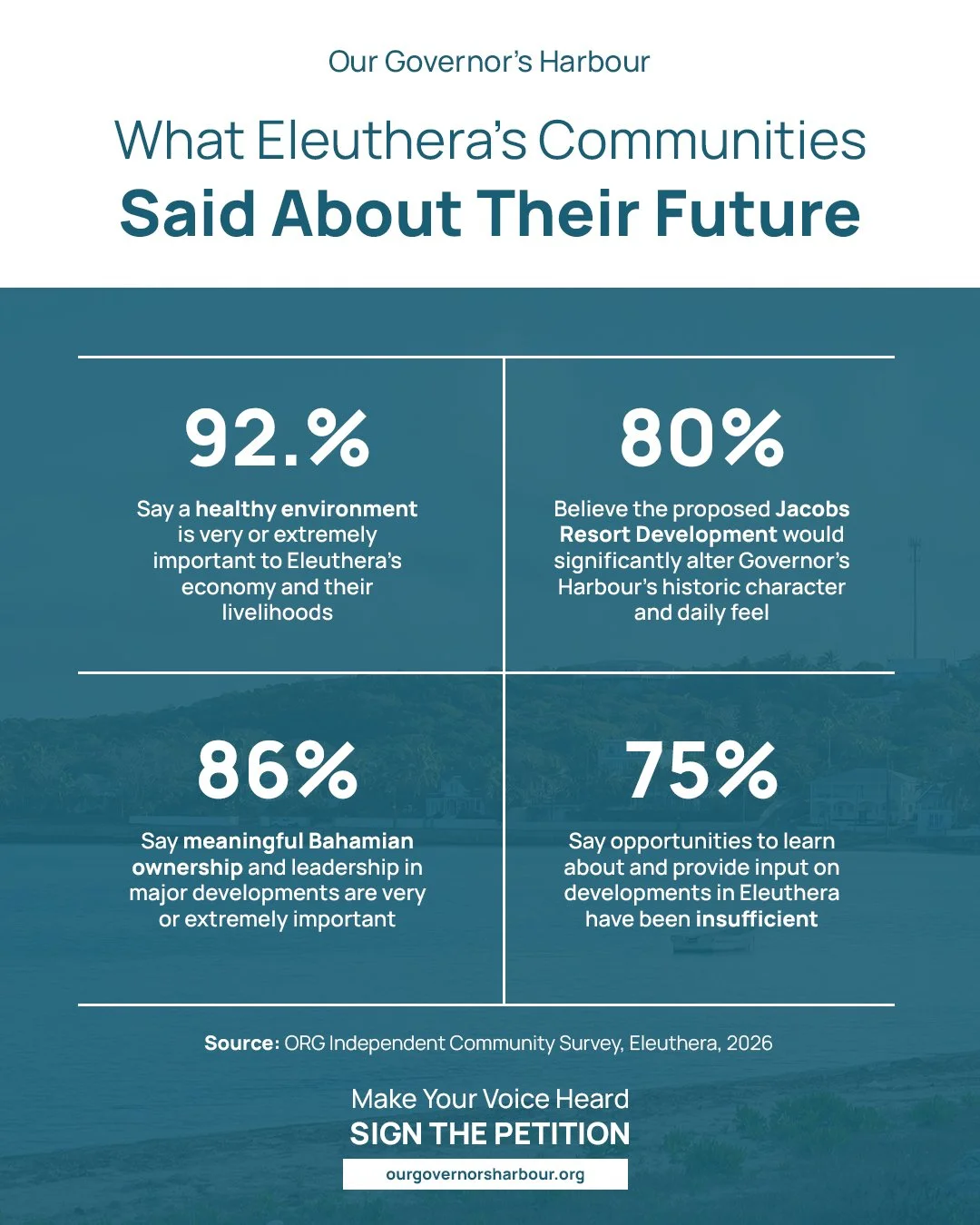
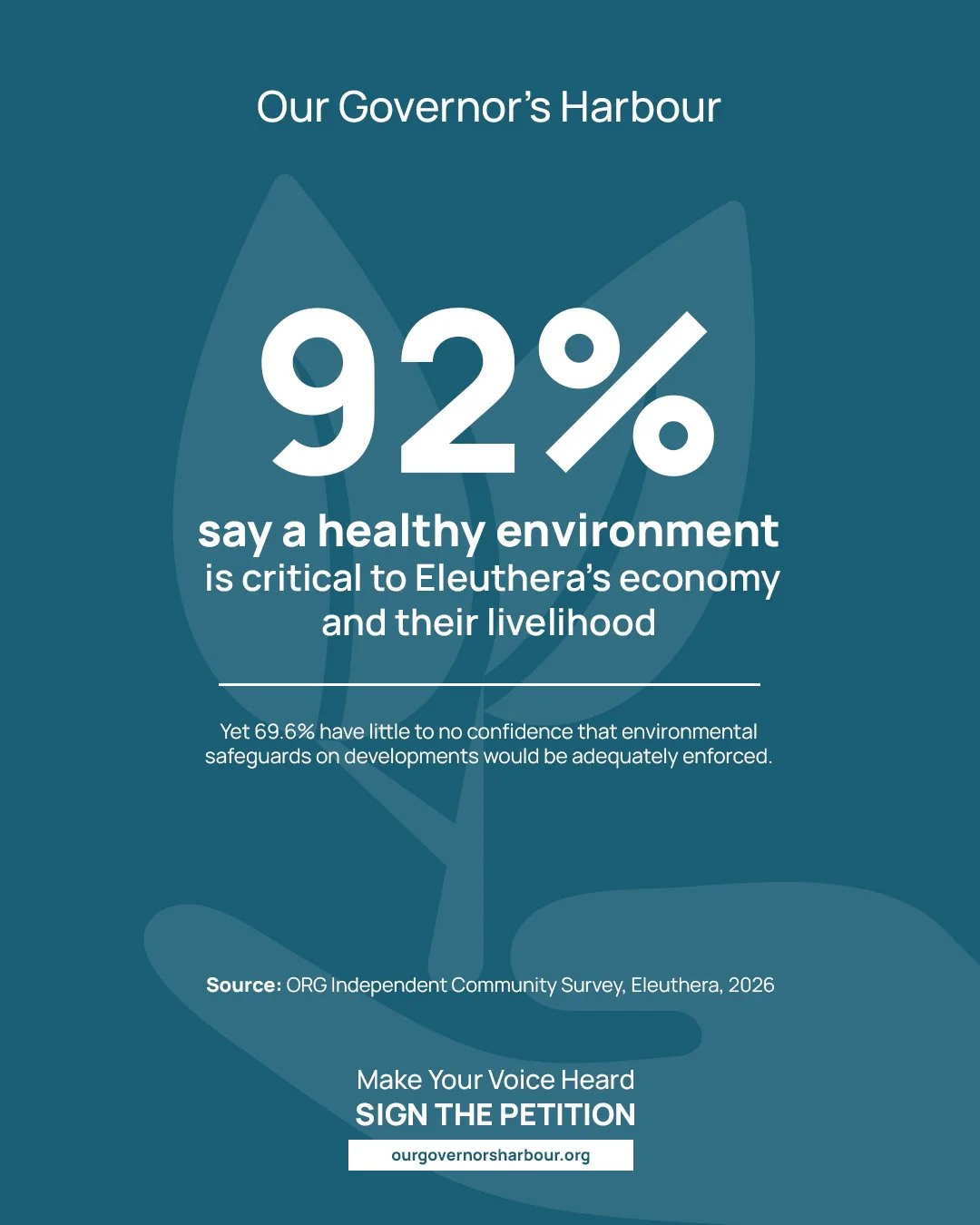
92.3% say a healthy environment is very or extremely important to Eleuthera's economy and their personal livelihoods
88% say the island's marine and coastal ecosystems are important or very important to them personally
73.9% expressed concern about the environmental impacts of large-scale tourism development
Respondents specifically cited dredging, marina construction, golf course operations, and waste management as areas of concern. Despite the strength of these environmental values, the survey revealed a significant gap in public confidence around enforcement.
69.6% of respondents expressed little to no confidence that environmental safeguards on developments would be adequately enforced — pointing to a longstanding deficit in public trust around environmental regulation.
Focus group participants across all three sessions reinforced this finding, describing environmental protection as requiring genuine government oversight, independent assessment, and collaboration with local credible organisations. Several noted that developers' environmental consultants face conflicts of interest, and called for transparent, publicly accessible environmental plans before any approvals are granted.
Residents Have a Clear View of What Governor's Harbour Is
Across both the survey and focus groups, residents articulated a strong and consistent sense of Eleuthera's identity, an island defined by its natural environment, its community character, and the quality of life it offers to those who live here. The survey asked respondents directly whether the proposed development aligns with that identity.
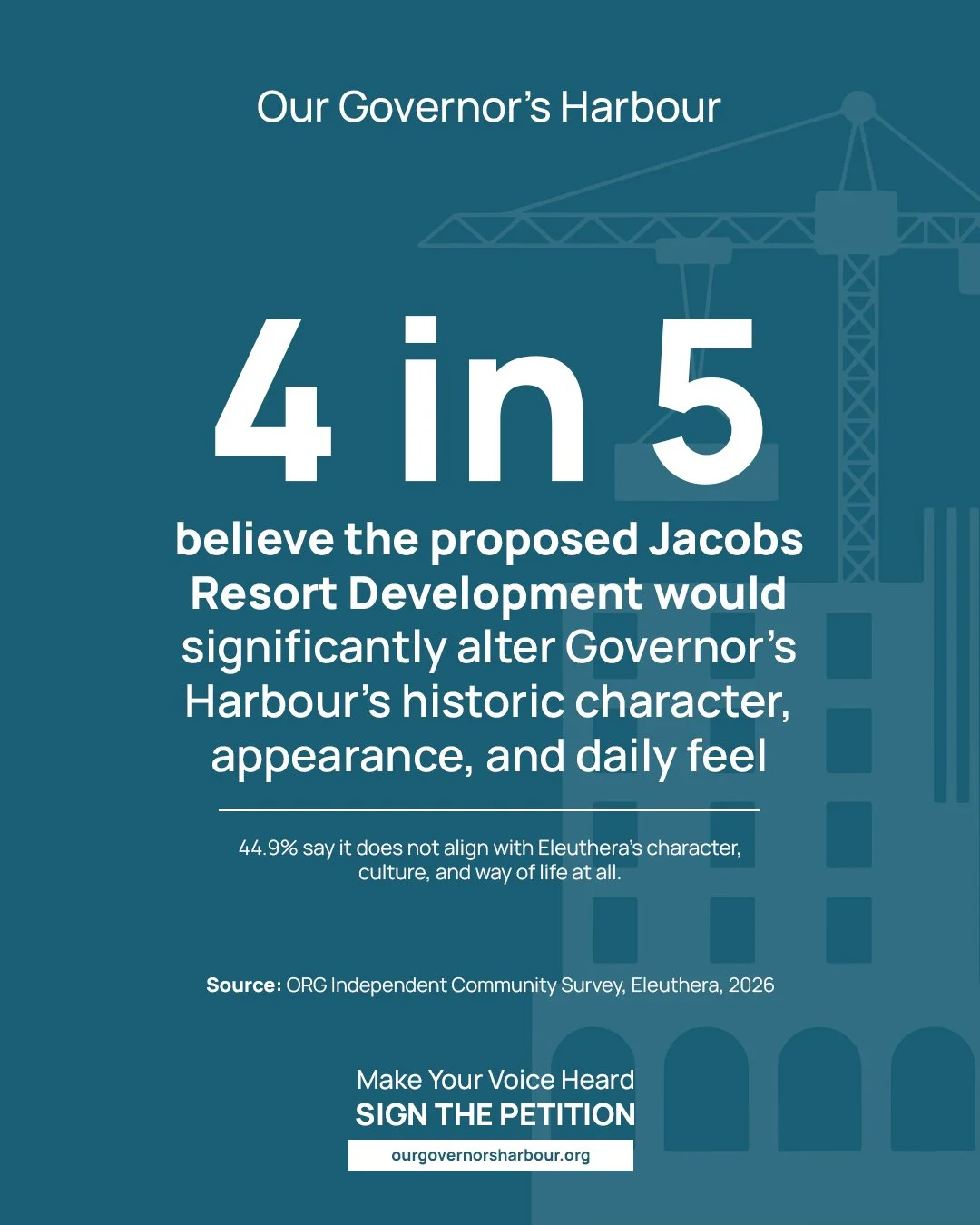
~80% believe the proposed Jacobs Resort Development would significantly alter Governor's Harbour's historic character, appearance, and daily feel.
44.9% say the proposed development does not align with Eleuthera's character, culture, and way of life at all -the single largest response to that question.
Open-ended responses consistently described a community that values its distinctiveness and is wary of development at a scale and character that serves visitors at the expense of residents. Focus group participants across all three sessions described Eleuthera as the "Isle of Freedom", an island defined by hospitality, natural beauty, and community cohesion, and expressed a clear preference for development that complements rather than overrides that identity.
Public Access to the Coast Is a Right, Not a Preference
Access to beaches and coastal areas emerged as one of the most visceral concerns across the entire survey. Qualitative responses made clear that residents regard coastal access not as a recreational preference but as a fundamental right, one they have watched erode through development elsewhere in The Bahamas, and in some cases on Eleuthera itself.
37.8% expect reduced public beach and coastal access
Among those who formed a view, residents expecting reduced access outnumbered those expecting improved access by more than three times. 32% expressed extreme concern about development-related changes to public land and coastal use. French Leave Beach in Governor's Harbour was cited repeatedly by name, with residents expressing specific concern about its future accessibility given its proximity to the proposed development site.
32% expressed extreme concern about development-related changes to public land and coastal use
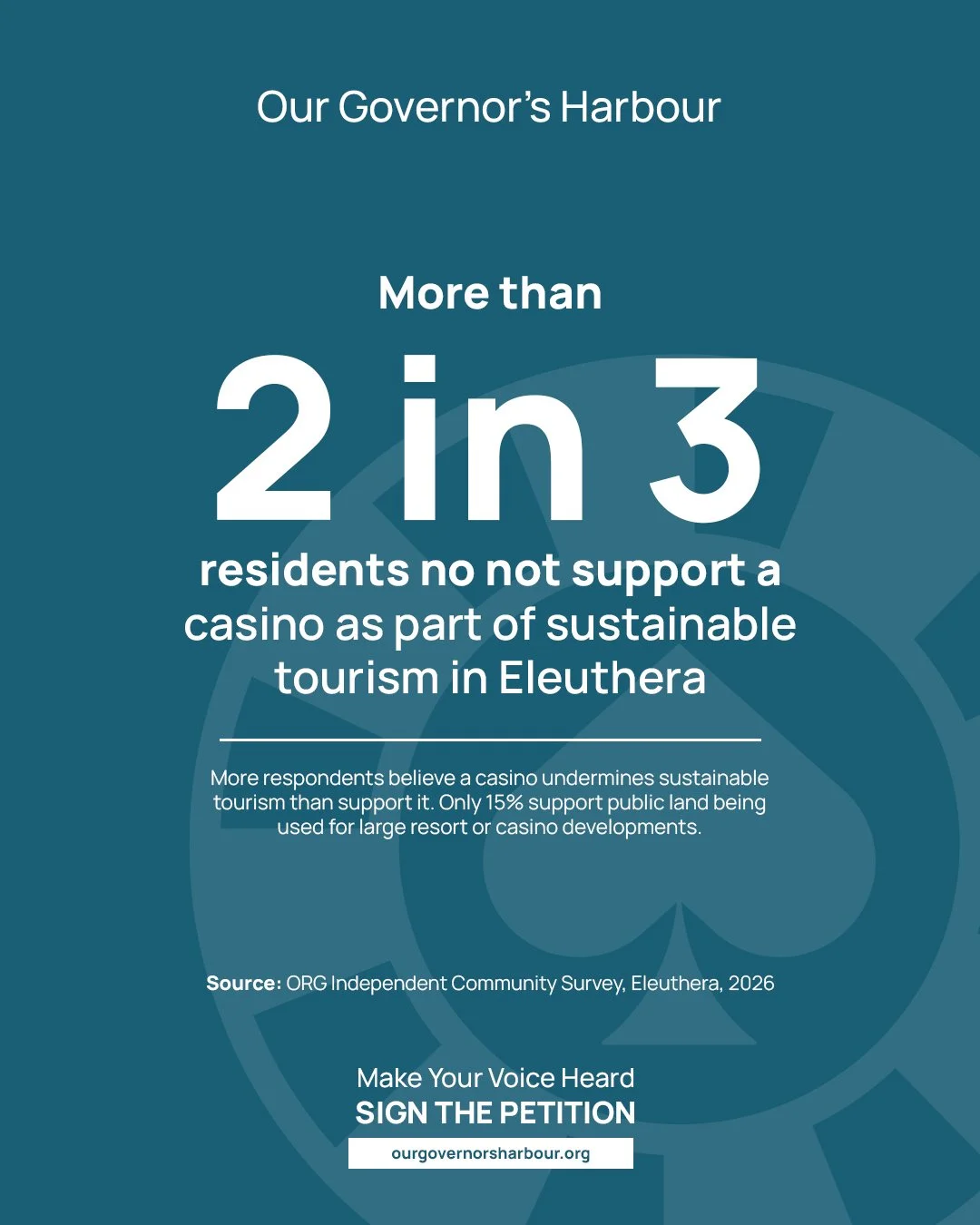
42.8% strongly oppose the use of public land for large resort or casino developments
Residents Want Growth — On Their Own Terms
The survey is unambiguous that Eleuthera's communities are not opposed to development. What residents want is sustainable development, growth that is environmentally responsible, culturally appropriate, and structured to deliver real, lasting benefit to the people who live here.
46.1% prefer a mixed development model. combining large and small-scale investment
32% prefer many smaller, locally rooted tourism and business projects
The preference for a mixed approach does not suggest opposition to all large investment. It reflects a community that wants development calibrated to what the island's environment and infrastructure can sustain, and that delivers benefits across the economic spectrum rather than concentrating returns among external investors.
Ownership and Leadership, Not Just Employment
Across both quantitative and qualitative responses, residents made a clear distinction between being employed by a development and genuinely benefiting from it. The survey found that community support for large-scale investment is closely tied to the extent to which Bahamians are included not only as workers, but as owners and partners.
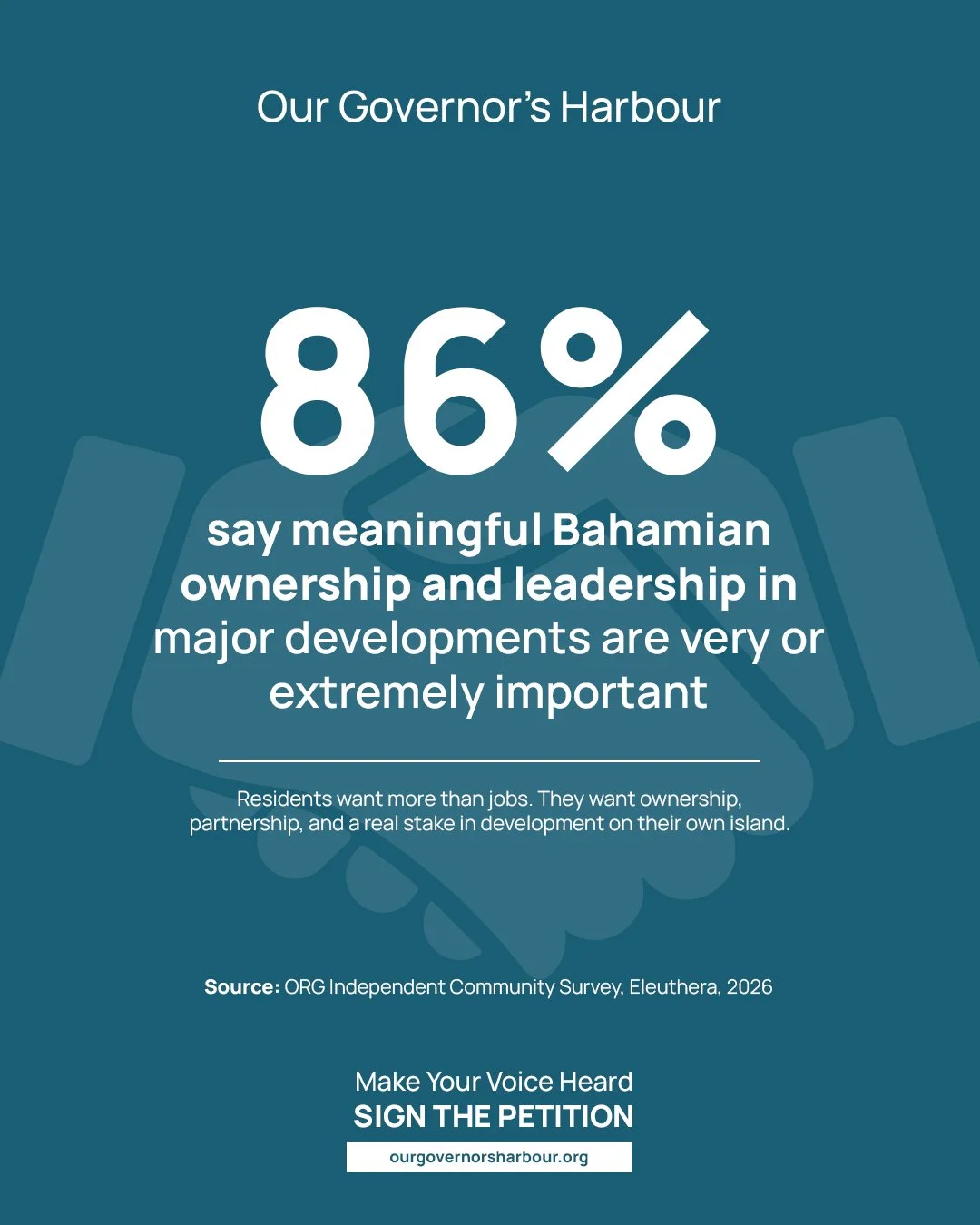
86% say meaningful Bahamian ownership and leadership in major developments are very or extremely important.
This finding was consistent across all settlement groups, age groups, and occupational backgrounds surveyed. Focus group participants went further, calling for structured mechanisms including minimum employment quotas, mandatory community investment percentages, and preferential procurement for Bahamian businesses and tradespeople.
Low Support for a Casino as Part of Sustainable Tourism
The survey found divided views on the inclusion of a casino in the proposed development, with more respondents believing a casino undermines sustainable tourism in Eleuthera than support it.
Less than 1 in 3 support a casino as part of sustainable tourism in Eleuthera
Qualitative responses reflected deeper reservations, with residents raising concerns about the casino's compatibility with the island's character, tourism identity, and community values. Focus group participants across all three sessions described a casino as culturally misaligned with Eleuthera's identity as a nature-based, community-oriented destination.
The Community Has Not Been Meaningfully Engaged
The survey also found that the majority of residents had limited awareness of the proposed development at the time of the research, underscoring the importance of early and meaningful community consultation before major development decisions are made.
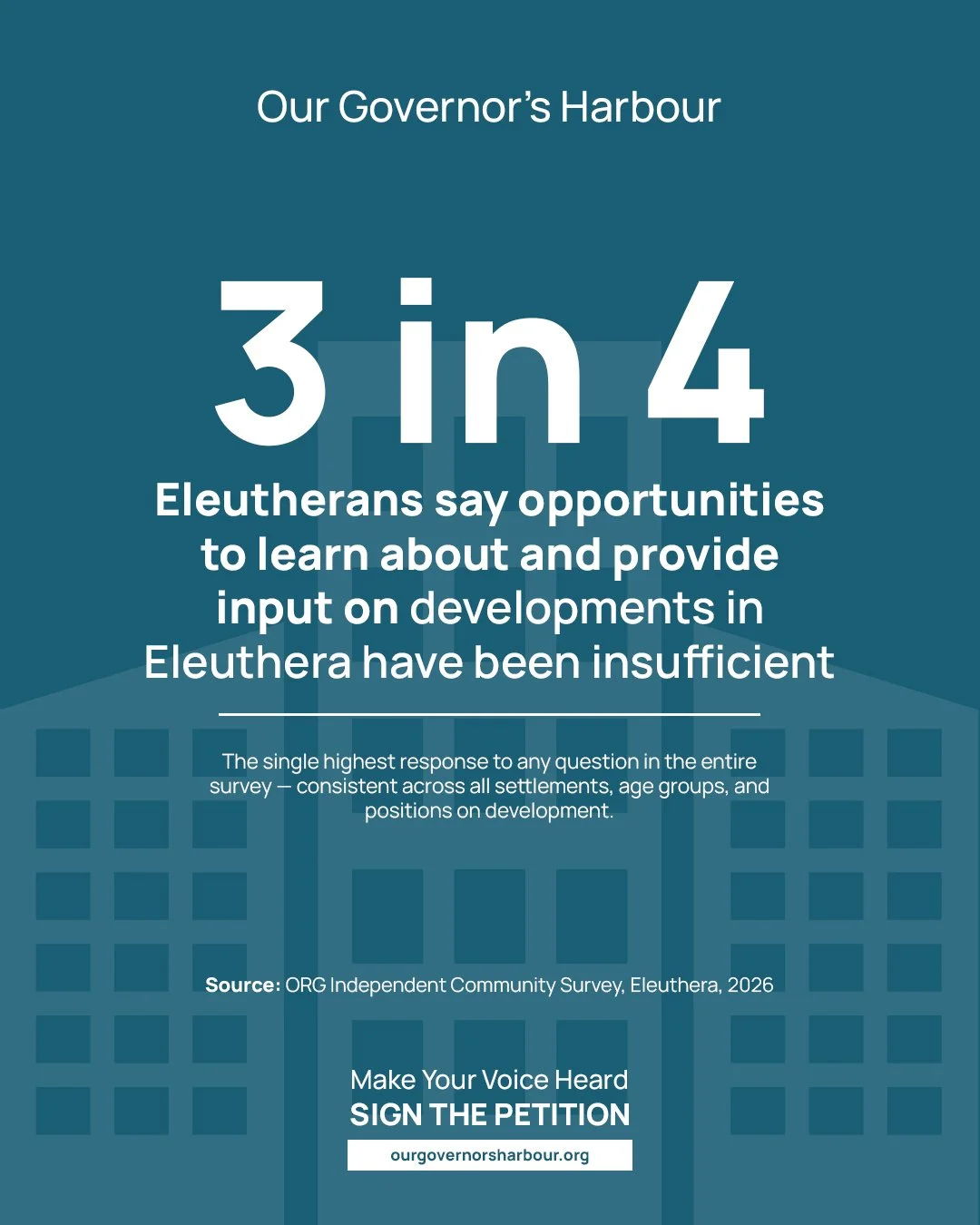
74.6% say opportunities to learn about and provide input on developments in Eleuthera have been "not at all sufficient", the single highest response to any question in the entire survey, consistent across all settlements, age groups, and positions on development.
49.4% do not trust information provided by the developer or government agencies regarding the project
38.4% believe community input has no meaningful influence on development decisions in Eleuthera
43.9% are not at all confident that promised public infrastructure would be maintained over time
Qualitative responses described a consistent pattern: consultations that occur after key decisions have already been made, input that does not appear to influence outcomes, and commitments that are not maintained once development is underway. Residents called specifically for consultation to happen before approvals are granted, not as a procedural formality, but as a genuine precondition.
In-Depth Community Dialogue Across Three Sessions
Complementing the walkabout survey, ORG conducted three structured focus groups across central and south Eleuthera in February 2026. Each session was designed to surface detailed community perspectives on three core themes, with a rapporteur present to document the substance and tone of discussions.
Each session followed a structured facilitation guide across three themes:
01 Scale, Identity & Environmental Protection - Participants' views on Eleuthera's environmental and cultural identity and how the proposed development might interact with it — including environmental risks, enforcement, and the role of Bahamian specialists in oversight.
02 Community Life & Social Impacts How the development could affect daily life in Governor's Harbour and surrounding settlements, including housing, traffic, infrastructure, public services, public access, and the inclusion of a casino.
03 Economic Impact, Governance & Public Trust Who stands to benefit economically, how local businesses and tourism operators could be affected, and whether residents have had meaningful opportunities to understand and influence the project.
Key Themes Across All Three Sessions
Across all three focus groups, participants consistently emphasised environmental protection, cultural preservation, responsible tourism, and meaningful local participation. There was broad consensus that smaller-scale, eco-conscious development better aligns with Eleuthera's identity.
Participants called for Bahamian environmentalists, not foreign consultants, to guide environmental oversight, and stressed that development must harmonise with the pace and character of community life. Infrastructure limitations were raised in every session: electricity, water, roads, waste management, and emergency services were all identified as systems that are already under strain.
On governance, all three groups expressed frustration at limited consultation, vague information from developers and government agencies, and a pattern of engagement that occurs too late to influence outcomes. Participants recommended formal mechanisms for community oversight, transparency on approvals, and enforceable accountability for developer commitments.
A Community With a Clear Vision for Its Future
The residents who participated in this survey, and focus groups , offer a picture of a community that is engaged, considered, and clear about what it wants. and what it does not.
Residents are not opposed to development. They are for development that protects Eleuthera's natural environment, preserves public access to the coast, respects the character of their communities, and delivers genuine, lasting benefit to Bahamians. They want to be informed before decisions are made, not consulted after the fact. And they want commitments that are upheld, not promises that disappear once construction begins.
These findings represent the community voice that should inform any major development decision affecting Governor's Harbour and the surrounding area of Central Eleuthera.
The full ORG survey report and focus group rapporteur report are available at orgbahamas.com.
Spread the Word
Below are shareable graphics summarising the key findings from the ORG Independent Community Survey. Download any card and share it on Facebook, Instagram, or WhatsApp to help make sure more people know how the community feels about development on their island.
Click any image to download.